
Kill Surprise Billing! Xi’an, China: He Checked In for Heart Surgery—His $80,000 Bill Included 34 Perineal Cleanings (1/2)
Real case from Xi’an, China: a father died 46 days after heart surgery—and his $80k bill hid 34 perineal cleanings. If you’ve ever been afraid to open a hospital bill, this story is about you.
Part 1 — A Life Lost, A Bill That Didn’t Add Up.
Gone: his life, his savings. Over four brutal years, a Chinese grad student dug through her late father’s $80,000 hospital bill and found 34 perineal cleanings on a heart-surgery chart—uncovering a black hole in how hospitals bill and insurers pay.
Hook
“My dad had heart surgery. So why did his bill say he’d had thirty-four perineal cleanings?”
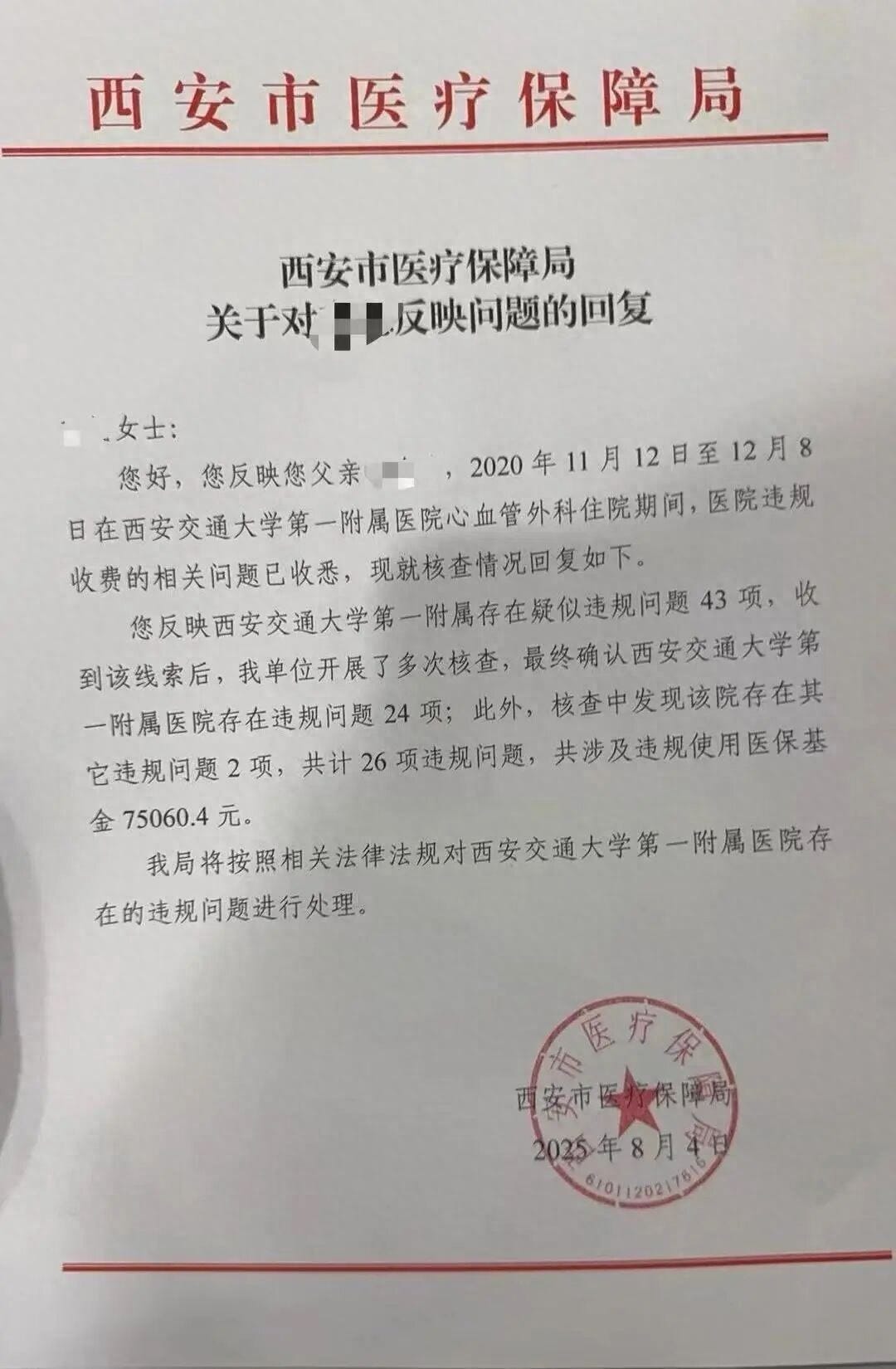
Document from the Xi’an Municipal Medical Security Bureau, Xi’an (a major city), China. Image provided by the interviewees.
The first time Li, a graduate of Xi’an Jiaotong University, saw that line on the hospital invoice, she thought she’d misread it. Her father had been on a cardiac ward, not in urology or gynecology. He’d gone under the knife for an aortic valve problem. Forty-six days later, he was dead.
Now she was staring at a stack of charges totaling roughly 600,000 yuan—close to US$80,000. About half had been covered by China’s public insurance system. The rest was on her family.
On the itemized bill, the numbers marched down the page in clinical black and white: ICU stays, lab work, imaging, surgery fees. Nestled in the middle was a line she couldn’t make sense of:
Perineal cleaning × 34.
Her fingers tightened around the paper. The grief she’d been trying to swallow for months suddenly twisted into something sharper: suspicion. Her father’s death had already left a hole in the family. Now the bill was opening a different kind of hole—one in her trust in the hospital, the system, and the white coat she’d grown up taught to respect.
This wasn’t where the story started. Back in the autumn of 2020, there had been no mystery, no bill, no legal filings. Just a routine checkup, a few worrying test results, and a doctor who said one sentence that would set everything in motion:
“You need surgery.”
I. Before the Surgery: Trusting the “Best” Hospital
In China, like in many countries, big teaching hospitals sit at the top of the medical food chain. Xi’an Jiaotong University First Affiliated Hospital is one of them—a flagship “Class A, Grade 3” institution, the kind of place people travel across provinces to reach. If you live in Xi’an and can get a bed there, you’re supposed to count yourself lucky.
Li did more than trust the brand. She trusted the badge on the wall because it was also her own. She had earned her master’s degree at Xi’an Jiaotong University. These were, in a way, “her people.”
In early autumn 2020, her father went in for a routine checkup. He was aging, but not fragile. The tests came back with a phrase that sounded serious but not catastrophic: moderate aortic valve stenosis—a narrowing of one of the heart’s key valves.
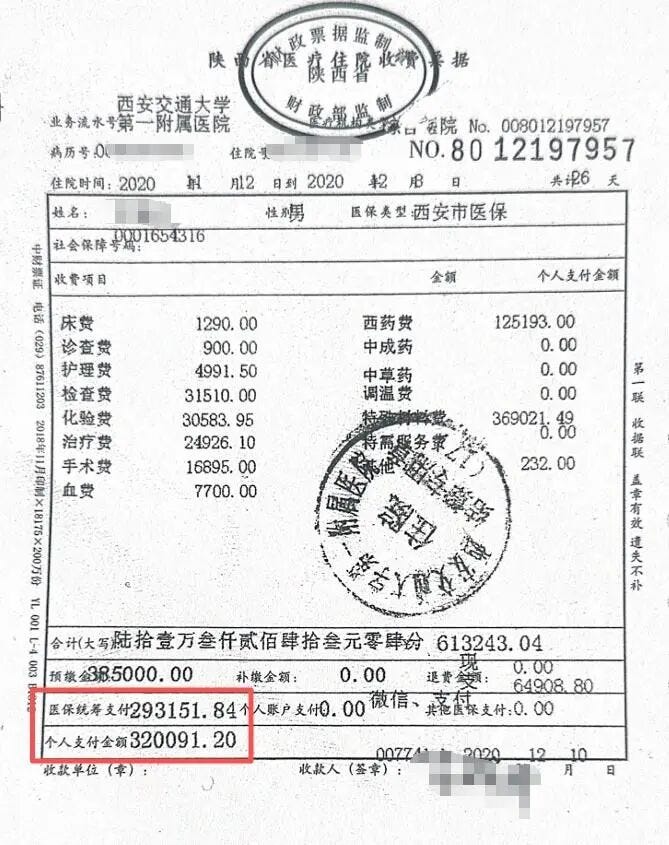
Medical Payment Statement. Image provided by the interviewee.
To a specialist, that phrasing sits in a gray zone. Some patients are watched. Some are treated conservatively. Some eventually need an operation.
To Li and her family, it landed as one thing only: a problem to be fixed.
The cardiologist didn’t linger on the options. Li remembers no long talk about “watchful waiting” versus surgery, no chart laying out risks and benefits, no plain-language discussion about what “moderate” actually meant.
What she remembers is almost a command:
“He needs surgery.”
There was no shouting, no overt pressure—just the quiet gravity of a doctor in a white coat at one of the country’s best hospitals. For many families, that’s enough. You don’t debate. You comply.
Li moved fast. She arranged her father’s admission, helped pack his things, and tried to soothe her mother’s nerves. On paper, everything looked like the responsible choice: a serious diagnosis, handled by serious professionals in a serious hospital.
What no one did was sit the family down for a different kind of conversation—the one that rarely happens in real life:
Is surgery absolutely necessary now for a moderate condition?
What are the non-surgical options and their trade-offs?
What are the realistic risks—not just of the operation, but of the days and weeks afterward?
And what will this actually cost?
They signed consent forms. They trusted the experts. No one mentioned that a single artificial valve would later show up on the bill as a nearly 280,000-yuan out-of-pocket charge—tens of thousands of dollars for one piece of hardware inside her father’s chest.
At the time, Li didn’t know to ask. She wasn’t a cardiologist. She wasn’t a lawyer. She was a daughter trying to do the right thing.
When the day finally came, the family gathered outside the operating room. The corridor smelled faintly of disinfectant and stale coffee. Hours ticked by. When the surgical light above the double doors finally went dark, Li let herself exhale.
She thought that was the moment her father’s second life began.
It wasn’t.
II. Forty-Six Days in Limbo
The first sign that something was wrong came quickly.
Instead of waking up in a normal ward, Li’s father was wheeled into the intensive care unit. He was unconscious. Tubes snaked out from beneath the blankets. Machines hummed and beeped a language only the staff could understand.
The family panicked. The surgeon and ICU doctors reassured.
“He’s stable.”
“Post-op ICU is standard.”
“Don’t worry too much.”
They clung to those words. In many cultures, questioning a senior doctor feels almost like blasphemy. In China, with its deep respect for hierarchy and authority, it can feel impossible.
Days blurred. There were small improvements, small setbacks. Every time Li’s family asked, they heard versions of the same line: “We’re doing everything we can.”
Outside, life went on. Inside the ICU, time was measured in lab results and monitor readouts. Li brought clean clothes, paid deposits, signed forms she barely had time to read.
Forty-six days after the operation, just after the winter solstice, the call came.
Her father was gone.
There was no dramatic courtroom moment, no angry confrontation in a hallway. There was just a body, a grieving family, and a sense that something about the whole trajectory—from “moderate stenosis” to open-heart surgery to death—had tilted off-axis.
But grief is heavy, and doubt is slippery. In the first weeks, Li focused on funeral rituals, on her mother’s shock, on just getting through the day. The “why” would come later.
It arrived, unexpectedly, in the form of a bill.
III. Sticker Shock: A 600,000-Yuan Bill and a 280,000-Yuan Valve
When the hospital’s itemized bill landed in Li’s hands, it was less like a document and more like a small book. Pages of codes and charges, most of them in jargon.
The headline number alone was staggering: around 600,000 yuan—close to US$80,000 at the time.
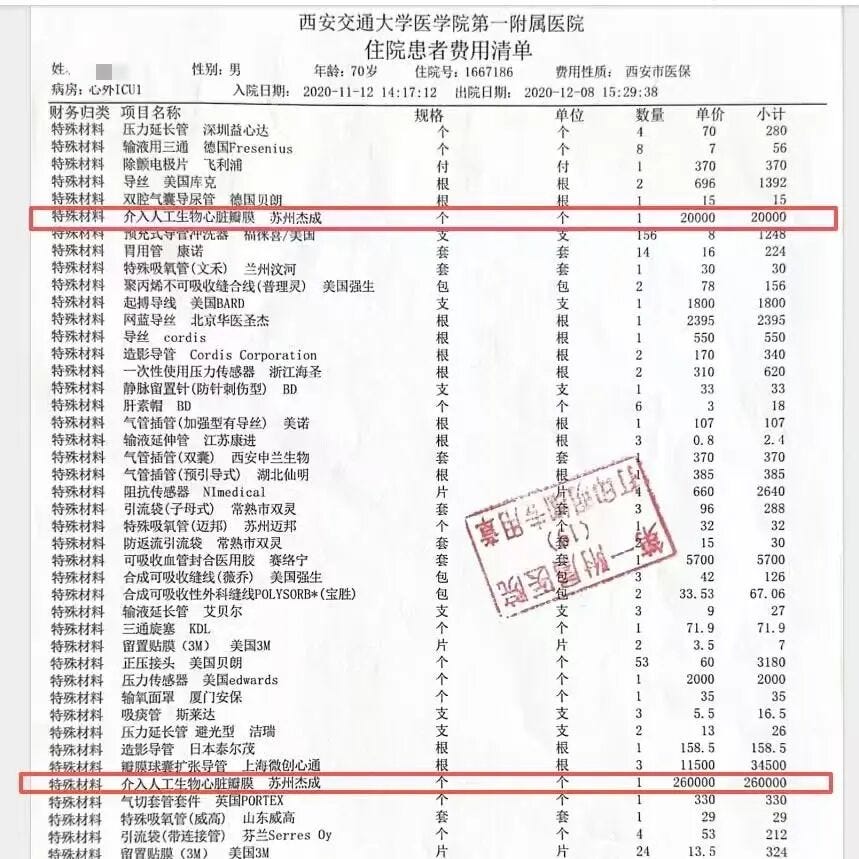
Medical Payment Statement. Image provided by the interviewee.
China’s national health insurance system covered roughly half. The other half was the family’s burden. For many middle-class households, that’s years of savings.
As she scanned the breakdown, one line item practically glowed:
Aortic valve prosthesis: ~280,000 RMB (self-paid).
No one had ever said that number out loud before the surgery.
No one had explained that, once you step into the operating room, you’re not just committing to a medical decision—you’re committing to a financial one that could weigh on your family for years.
The more she looked, the more numbers seemed to swell and blur. Medications, supplies, nursing care, lab tests, imaging. It was an ocean of costs. Most families, faced with a bill like this, pay what they can, fight a few obvious items if they’re bold, and move on. After all, the person who might explain what happened is either too exhausted, too traumatized, or no longer alive.
Li might have done the same—if it weren’t for one strange line.
IV. The Line That Didn’t Belong
Buried among the usual suspects—lab tests, X-rays, consumables—was something that made no sense.
Perineal cleaning × 34.
Perineal care is a type of intimate hygiene procedure. It might be expected after childbirth, certain urological surgeries, or in long-term bedbound patients.
Her father had gone in for heart surgery.
Li reread the line. Maybe she’d misunderstood the Chinese term? She checked again. There was no mistake.
Thirty-four times.
She tried to imagine the scene: her father, already fragile after his chest was opened and wired shut, being put through this procedure over and over again. No one had ever mentioned it. No one had said he’d developed complications that required such care.
Was it necessary? Was it a documentation error? Or was it something else—padding?
That one line snapped something into place in her mind. Grief shifted into a kind of cold determination.
If the bill contained one thing that clearly didn’t belong, what else was hiding there?

Most of us aren’t doctors, lawyers, or auditors. We’re just people who sign forms in fear and pay bills when we’re exhausted.
This isn’t just a story from Xi’an, China — it’s a warning for anyone who’s ever dreaded opening a hospital bill. Ask. Read. Push back when something doesn’t add up. One bill, one case, one complaint at a time — that’s how we start to kill surprise billing for good.
Comments (0)